
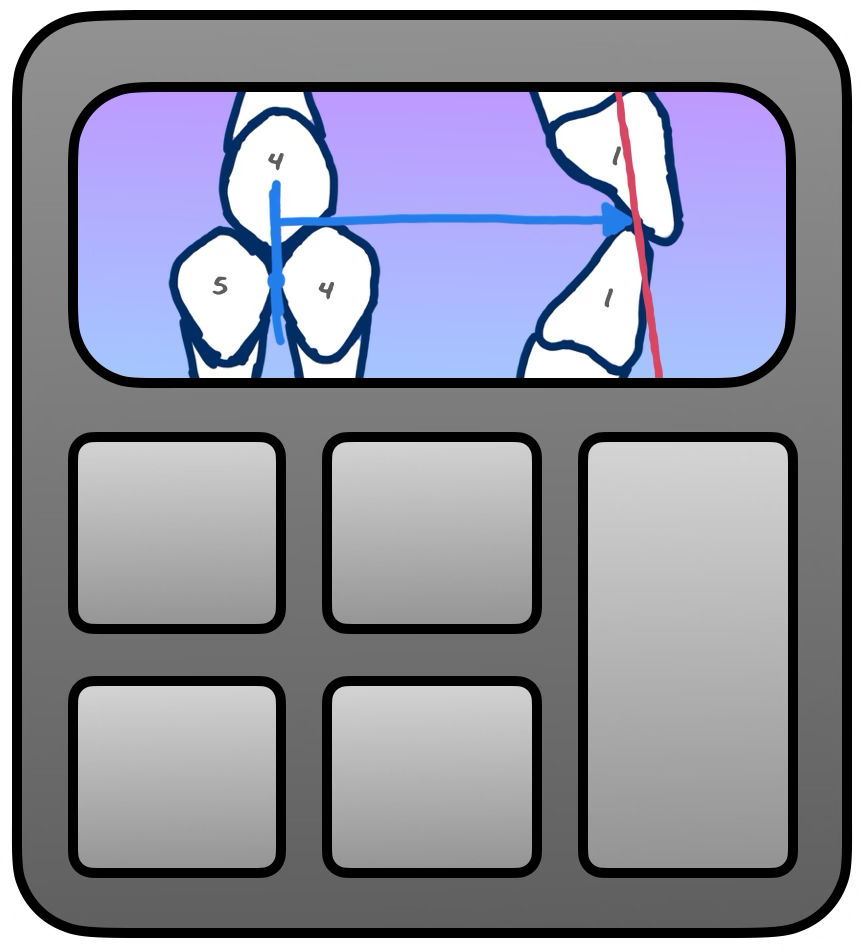
TREATMENT PLAN
CALCULATOR
For cases that are significantly asymmetric and require extractions, consider using Super Calculator instead!
about this calculator
PURPOSE
The Treatment Plan Calculator is designed to provide orthodontic professionals with a streamlined tool for diagnosis and treatment planning. By leveraging a computer-based algorithm focused on two key diagnostic criteria—buccal malocclusion and desired incisor position—users can make objective treatment decisions. This calculator aims to enhance consistency in treatment outcomes and improve confidence, especially in critical areas such as extraction decisions.
HOW TO USE
Input Patient Data
Classification: Classify the malocclusion as Class II or Class III.
Severity: Measure the severity of malocclusion.
Upper incisor position: Imagine the upper arch levelled and aligned non-extraction; select if the U1s need to move forward, stay where they are, or come backward.
Lower incisor position: Similarly, evaluate the lower arch to determine if the L1s should move forward, remain in place, or move backward.
Output
Instant results: Within seconds, the algorithm processes the input and provides a comprehensive treatment plan.
Author Tips
Measuring: When measuring severity, consider using the Katz classification of malocclusion (measured at the 4th tooth back). This is a strong indicator of the true A-P discrepancy between the Mx and Md arches, less influenced by individual tooth positions (e.g., tipped canines or rotated molars).
Reference line: Use your preferred reference line to plan incisor position, such as the N-A line (cephalogram), or Glabella vertical (extra-oral exam). The authors have had success using the N-A line to guide planned incisor position, where U1s should end up just ahead of the line and L1s should be ±1mm from the line.
REFERENCES
This calculator was created in collaboration with Dr. Anthony Mair, a clinical expert in diagnosis and treatment planning, from simple to the most challenging of cases.
Please view the references section which includes key references regarding ideal incisor position and extraction space closure.
EXAMPLE
Coming soon.
DISCLAIMER
The information provided is intended solely for informational and educational purposes for licensed dental professionals. The orthodontic calculators, while based on evidence from reputable orthodontic literature as well as clinical experience, are tools designed to assist clinical decision-making. They are not intended to make final treatment decisions. Do not take the outputs from these calculators at face value; they are meant to complement, not replace, professional judgment and critical thinking.
These calculators are generalized and not customized for any specific patient case. It remains the responsibility of the treating orthodontist or dentist to thoroughly assess and tailor care to each patient’s individual needs. By using this tool, you acknowledge that the ultimate responsibility for patient care lies with the treating clinician. Ortho Calculator Inc. will not be held liable for any risks, complications, or outcomes associated with acting on the information provided by this website.
The ortho calculators are not intended for use by the general public. If you are not a licensed dental professional, please refrain from using or relying on the calculators or content provided here. By using the Ortho Calculators, you acknowledge and agree to the terms outlined in this disclaimer.